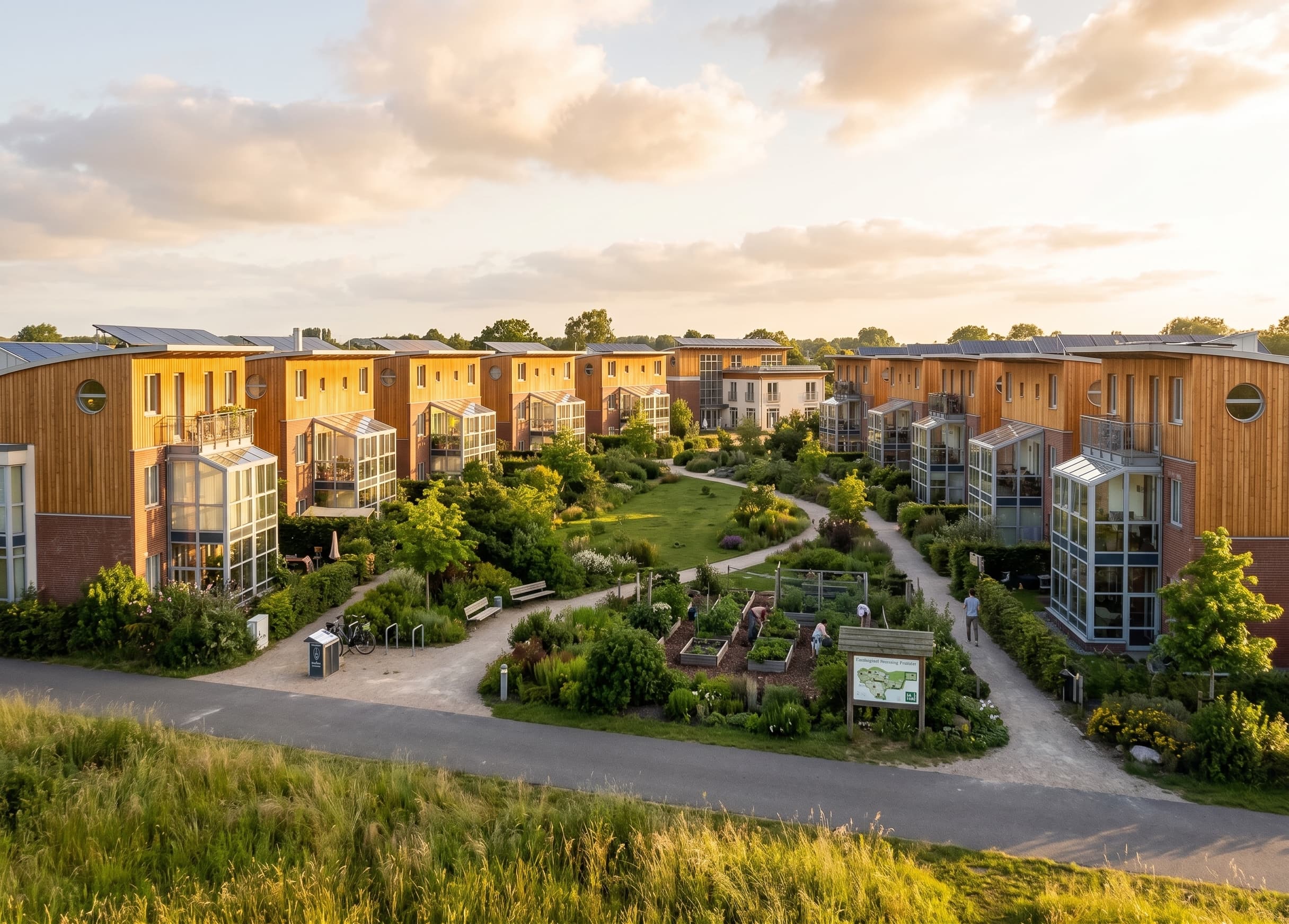
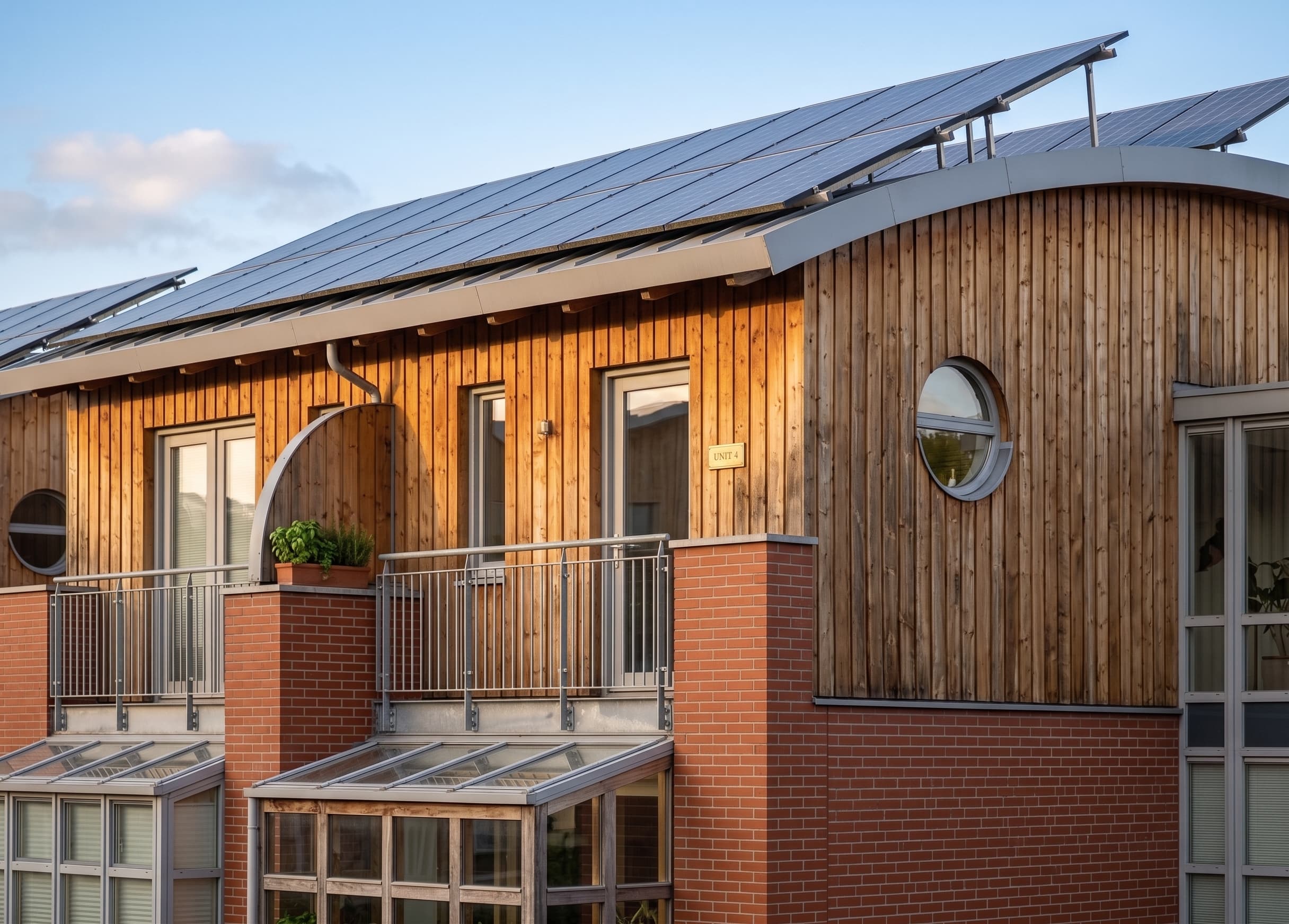
On 5.6 hectares in Lübeck, up to 380 people live in a settlement that generates its own power and heat, treats its own water, and turns its own waste into fuel and fertiliser. What it takes from outside is drinking water and a little gas. It was registered for World Expo 2000, funded as a federal pilot, and has been running for twenty-five years.
- Location
- Lübeck, Germany
- Competition won
- 1995
- Built from
- 1999
- Site
- 5.6 ha, 2.1 ha kept green
- Units
- ~120, up to 380 residents
- Role
- Architect & urban design
Measured outcomes
Third-party figures, against comparable conventional development.
Drinking-water use
Operating costs
CO₂ reduction
In operation
One system, not one building
The task was never a single eco-settlement. Flintenbreite was conceived as the built test bed for a planned university quarter of some 3,500 dwellings — proof that a whole district could be developed around closed cycles. That made it a piece of system planning: urban structure, landscape, social organisation, energy and sanitation had to work as one design.
The architecture and urban design were Rüdiger Fleck’s; the sanitation engineering came from OtterWasser, the building services from a Lübeck engineering office. The architect’s part was making the system inhabitable — getting vacuum lines, a district-heating ring and a technical building to coexist with a neighbourhood people actually want to live in.
Source separation, by design
Black, grey and stormwater are kept apart from the outset. Roughly 90% of the nitrogen load sits in the blackwater, so mixing the streams is exactly what turns sewage into a disposal problem. Here vacuum toilets collect the concentrated blackwater separately; greywater is treated in vertical-flow constructed wetlands; stormwater infiltrates on site.
The concentrated blackwater is digested anaerobically together with household food waste. The digestion produces methane, which runs a combined heat-and-power unit. The residue is a high-grade liquid fertiliser that goes to a farmer and back onto farmland.
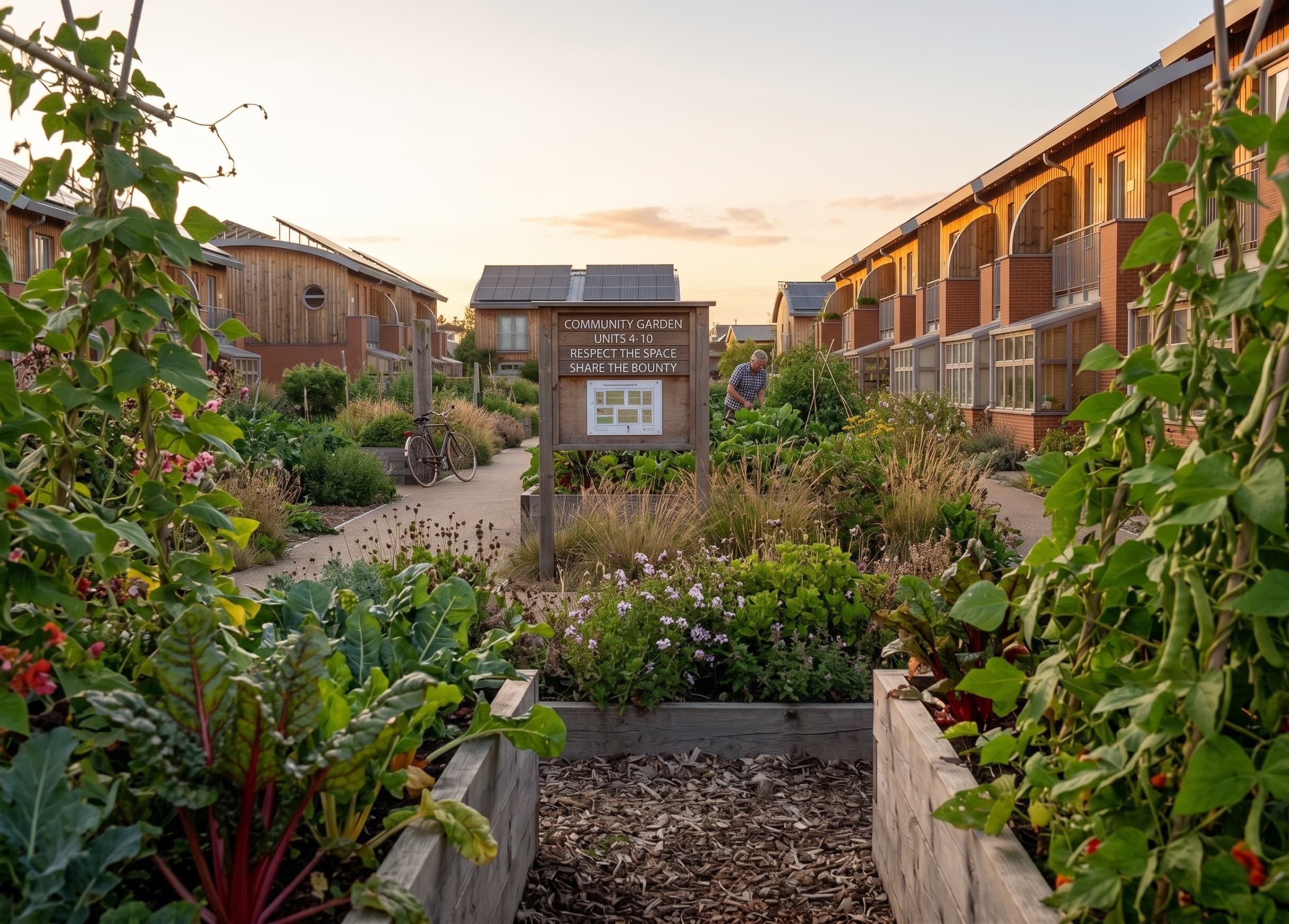
Owned by the people who live there
The infrastructure is not run by the municipality or a contractor but by infranova, a utility company founded for the purpose in 1997. It supplies the settlement with drinking water, heat, electricity and television, handles the waste streams — and its partners include the residents themselves, each stake carrying a direct say over the shared plant, the community house and the reserves.
In Rüdiger Fleck’s words: “We didn’t only offer the purchasers a technical structure — we obliged them to be co-owners of all the plant. That was almost revolutionary at the time, and I believe it is the only reason the system still works today.” The company still files accounts after twenty-five years, a developer insolvency, several changes of ownership and five construction phases.
The honest record
The system worked; the financing did not. The developer went insolvent in February 2001, and the settlement stalled at roughly a third of its planned size — documented by the federal environmental foundation, not merely claimed. Later builders changed the architecture to conventional terraced houses, but kept the urban plan and the water concept through five construction phases: the design outlived its developer.
The technology has vulnerabilities Fleck watched for years — contamination of the nutrient stream by household chemicals, and the fragility of the vacuum collection on which the concentration of the whole cycle depends. His own assessment: “Because of these vulnerabilities, the systems are better suited to the smaller, decentralised scale — unless the technology is developed onward with real consistency.”
What it set in motion
The settlement became the material of research in a quite literal sense: a TU Hamburg-Harburg dissertation used its blackwater as experimental substrate for over a year, and the United Nations documented it as Germany’s best-practice case study in water and sanitation. The concept was replicated in Sneek in the Netherlands, planned in extended form as the Hamburg Water Cycle, and applied in districts of Beijing.
In one line
Needs no sewer connection — but can be connected if required.
Ralf Otterpohl, sanitation engineer, on the settlement’s water system
The operating record
In the record
Credit
Architecture and urban design: Rüdiger Fleck. Sanitation engineering: OtterWasser (Ralf Otterpohl). Building services: a Lübeck engineering firm.
Next project
Clever Brise